
Vibrating Screen
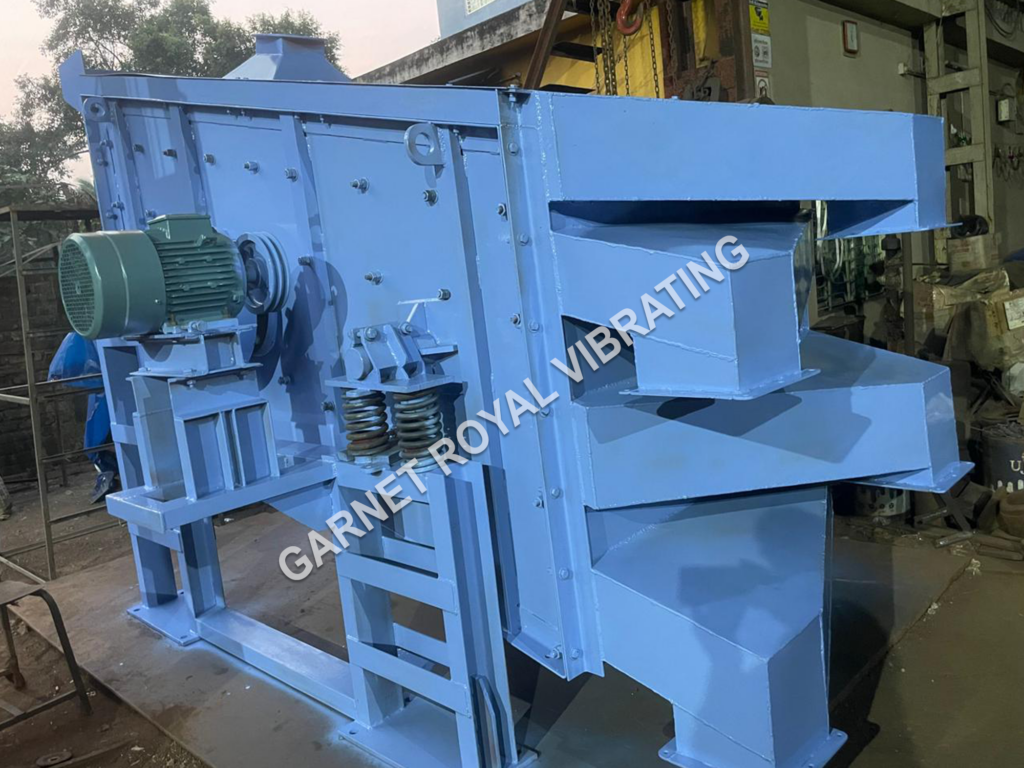
The Garnet Royal vibrating screen separates bulk material into sized fractions by shaking a deck of mesh or perforated plate so the bed stratifies and undersize passes through the aperture. It is built for sizing and grading duties in aggregate, mineral and process plants, from a single deck up to a four-deck separation, covering throughputs from 500 kg to 100 TPH. Machines are supplied in circular-motion and linear-motion forms — the difference is the path each point on the deck travels, and it decides which duties the screen suits.
Technical specifications
| Machine type | Motion Vibro Screen |
| Automatic | No |
| Capacity | 100 kg – 100 Tph. |
| Computerised | No |
| Delivery Time | 45 Day |
| Feature | High Efficiency |
| Main Market | All of India, Nepal, Bhutan, Russia, Bangladesh, Zambia, and Iraq. |
| Material | Steel, fabricated and others |
| Minimum Order Quantity | 1 |
| Supply voltage | 400 – 420 volts |
Specifications are indicative and configured to your application. Share your material, feed size and required output for an exact model recommendation.
Key features
- A counter-weight mechanism on the drive shaft lets amplitude be tuned on site without changing the drive.
- Up to four deck separations, producing as many as five graded fractions in one pass.
- Wide operating window from 500 kg pilot duties to 100 TPH plant throughput.
- A steep circular throw keeps the bed open and reduces pegging and blinding of the mesh.
- Interchangeable woven wire, perforated plate, polyurethane and rubber media on every deck.
- Live frame built from stress-relieved fabricated sections with sealed, screen duty bearings.
- Spring or rubber suspension isolates vibration from the supporting structure.
- Quick-release tensioning rails and side liners for fast media changeover.
Applications
- Aggregate and sand grading in crushing and screening plants
- Sizing and classification in mineral beneficiation circuits
- Coal and coke screening ahead of washing or combustion
- Scalping of oversize before crushers and mills
- Product grading in cement, refractory and ceramic works
- Fertiliser and chemical granule classification
- Foundry sand reclamation and recycling lines
- Recycling and construction-waste sorting plants
Frequently asked questions
Should I choose circular motion or linear motion?
Circular motion suits inclined, dry sizing where high volumetric capacity and a compact footprint matter, because gravity does the conveying. Linear motion suits horizontal installations, low headroom, damp or wet feeds and dewatering duties, since its straight-line throw both conveys and stratifies. If the feed is dry and free-flowing, circular motion is usually the more economical choice for a given tonnage.
How is the vibration amplitude adjusted?
The drive shaft carries a counterweight assembly whose segments can be added, removed or rotated relative to one another. Increasing the out-of-balance mass lengthens the stroke for coarse or heavily loaded duties; reducing it shortens the stroke for fine, accurate cuts. The change is mechanical and can be made on site during commissioning, with no alteration to the motor or drive train.
What throughput can the machine handle?
The range covers 500 kg to 100 TPH. Actual capacity depends on bulk density, moisture, aperture size, the near-size fraction in the feed and the efficiency you require, so we size the deck area against your material rather than against tonnage alone.
Can it screen damp or sticky material?
The standard machine is designed for dry feeds; damp or cohesive material tends to blind woven mesh. Where some moisture is unavoidable, we specify self-cleaning polyurethane or rubber panels, ball-tray anti-blinding decks, a longer stroke, or spray bars for wet screening. Persistently wet duties are usually better served by a linear motion screen or a trommel.