Ribbon Blender
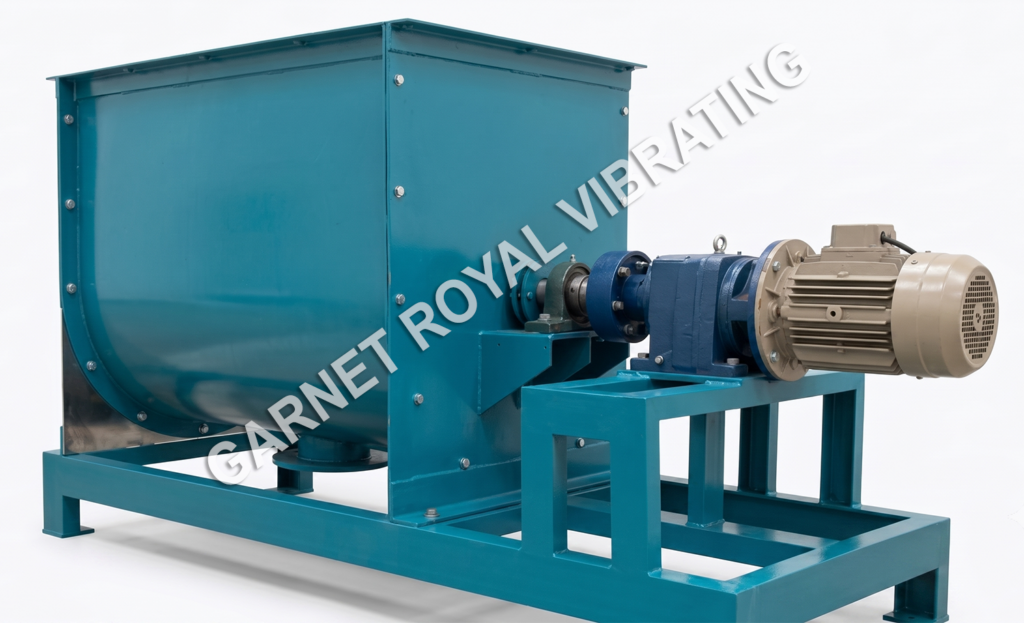
The Garnet Royal ribbon blender is a batch machine for the gentle, uniform blending of dry powders and granules. A double-helical agitator turns inside a U-shaped trough, moving material outward along one ribbon and inward along the other so the whole charge circulates without being crushed. Batch sizes run from 50 kg to 500 kg, in mild steel or stainless steel, with batch times measured in minutes rather than tens of minutes.
Technical specifications
| Type | Ribbon blender, double-helical agitator, batch operation |
| Mixing mechanism | Inner and outer counter-wound ribbons producing axial cross-flow |
| Duty | Gentle homogeneous blending of dry solids, with minor liquid addition optional |
| Batch capacity | 50 kg – 500 kg per batch |
| Fill level | 40 – 70 per cent of gross trough volume for correct ribbon action |
| Blend time | 5 – 15 minutes typical, material dependent |
| Trough | U-section, with dust-tight hinged or bolted top covers |
| Contact parts | Mild steel, stainless steel 304 or 316; food-grade finish optional |
| Discharge | Central slide valve or butterfly valve, flush with the trough profile |
| Shaft sealing | Gland packing standard; PTFE or air-purged seals optional |
| Liquid addition | Spray lance for minor liquid or additive dosing, optional |
| Drive | Geared motor with chain or direct coupling |
| Supply voltage | 400 – 420 V, 3-phase, 50 Hz |
| Machine weight | Approx. 0.5 – 4 tonnes across the model range |
| Finish | Painted mild steel or mirror/matt polished stainless steel |
| Installation | Floor-mounted on fabricated legs with charging platform where required |
Specifications are indicative and configured to your application. Share your material, feed size and required output for an exact model recommendation.
Applications
- Dry powder formulation and recipe blending
- Minor and micro-ingredient dispersion into a bulk carrier
- Food, spice and nutraceutical batch production
- Pigment and filler pre-blending before compounding
- Animal feed and premix manufacture
- Detergent and household chemical blending
- Pharmaceutical intermediate blending in stainless steel execution
Frequently asked questions
How do I choose between pan, paddle and ribbon mixing?
A ribbon blender is gentle, batch and dry — the choice when particle integrity matters and no liquid is involved. A twin-shaft paddle mixer is continuous and much faster, and suits high tonnage blending of free-flowing solids. A pan mixer is intensive and batch, and is the only one of the three that will work a liquid binder into a heavy or abrasive material.
Can a ribbon blender handle liquid addition?
Small quantities, yes. A spray lance can be fitted to dose oils, flavours or binders at low percentages, and the ribbons will distribute them adequately. Beyond a few per cent by weight the material begins to ball up and stick to the ribbons, because there is no shearing action to break the agglomerates. For anything wetter, a pan or paddle mixer is the correct machine.
How full should the blender be?
Between about 40 and 70 per cent of gross trough volume. The double-helical action relies on material being free to move over the top of the ribbons and circulate back; overfilling stops that and the charge simply rotates as a mass. Underfilling leaves the material below the ribbon path, so it is dragged along rather than folded. Both faults show up as poor blend uniformity that longer running will not fix.
Is a longer blend time always better?
No. Every dry blend reaches an optimum uniformity, usually within five to fifteen minutes, and continuing past it can make things worse. Where components differ significantly in particle size or density, extended running allows them to segregate again as the finer or denser fraction migrates. We recommend establishing the correct time by sampling during commissioning and then fixing it on a timer.