Belt Feeder / Belt Conveyor
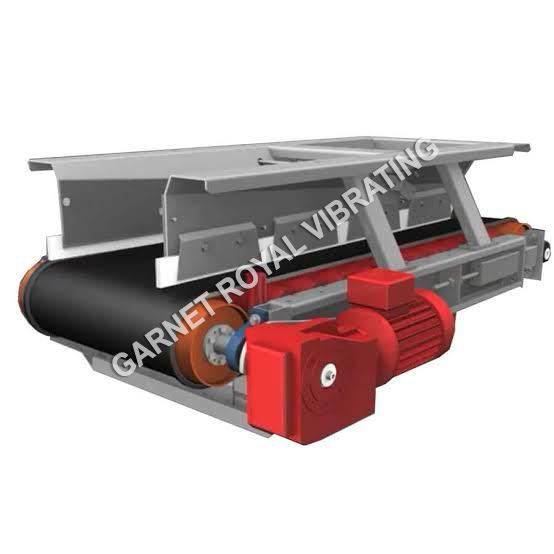
The Garnet Royal belt machine carries bulk material along a troughed rubber belt supported on idler rollers between a drive pulley and a tail pulley and is supplied in two duties. As a belt conveyor, it is the most economical way to move large tonnages of coal, ore, aggregate, clinker or grain over distances from a few metres to several hundred, level or on a rising gradient. As a belt feeder, the same principle is built short, wide and heavy and installed directly beneath a bin or hopper outlet, where its job is not to transport but to meter – to draw material out of the outlet at a controlled rate and keep it alive.
Technical specifications
| Product Type | Belt conveyor |
| Colour | Gray |
| Delivery Time | 45 Day |
| Main Market | All India, Nepal, Bhutan, Russia, Bangladesh, Zambia, and Iraq. |
| Material | Cast Iron |
| Minimum Order Quantity | 1 |
| Supply Ability | 10 Per Day |
| Supply voltage | 400 – 420 Volts |
| Machine weight | 400 – 500 kg |
Specifications are indicative and configured to your application. Share your material, feed size and required output for an exact model recommendation.
Key features
- Lowest cost per tonne-kilometre of any mechanical bulk conveyor.
- Troughed idler sets carry far more material than a flat belt of the same width.
- Rubber-lagged drive pulley with screw or gravity take-up for stable belt tension.
- Skirted, aligned feed chutes that load material at belt speed and cut spillage.
- Head and secondary belt scrapers to control carryback and return-idler build-up.
- Backstop or thruster brake on inclined runs to stop loaded roll-back.
- Pull-cord and belt-sway switches, plus zero-speed and chute-block detection.
- Open, hooded or fully galleried designs for outdoor and dusty environments.
Frequently asked questions
How steep can a belt conveyor run?
For most granular bulk solids the practical limit is 18 to 20 degrees, above which material rolls back down the belt. Damp fines will hold a slightly steeper angle and dry rounded aggregate rather less. Where the layout demands more lift in a short horizontal distance, we supply cleated or corrugated sidewall belts, or recommend a bucket elevator.
How is a belt conveyor different from a tripper or shuttle conveyor?
A plain belt conveyor has one fixed discharge point at the head pulley. A tripper conveyor adds a travelling carriage that lifts the belt mid-run and throws material off wherever the carriage stands. A shuttle conveyor instead moves the entire machine along rails, discharging over its own head pulley at whatever position it has travelled to.
What belt specification will my material need?
Carcass rating comes from calculated working tension, plies from the belt width and the impact of the load at the feed point; and cover thickness from abrasiveness and the frequency of loading. Sharp quarry rock needs a heavy top cover and a cut-resistant grade; hot clinker needs a heat-resistant compound; oily or greasy material needs an oil-resistant cover.
What causes a belt to run off-centre, and how is it corrected?
Mistracking almost always traces back to one of four causes: an off-centre or asymmetric feed, idlers or pulleys out of square with the centre line, material build-up on a pulley face or return roller, or a belt joint that is not cut true. Correct the feed chute and structure first; training idlers should be a refinement, not a substitute for alignment.