
Rotary / Drum Dryer
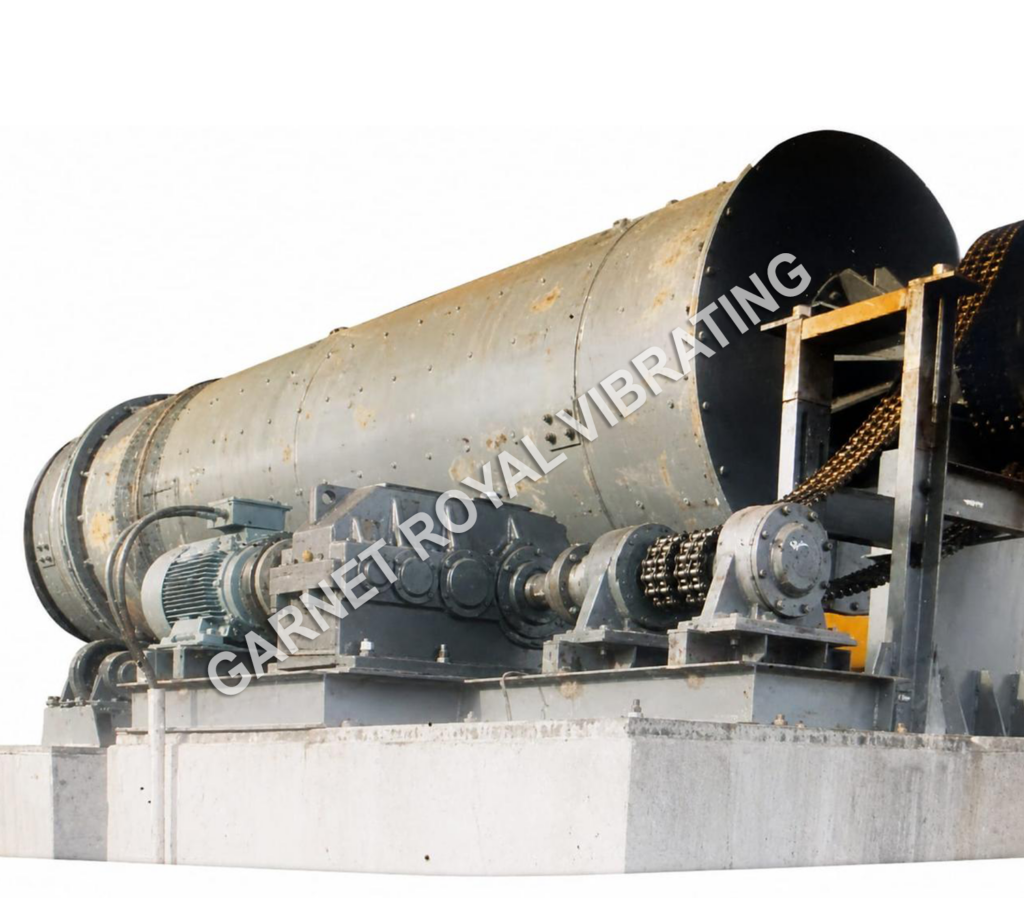
The Garnet Royal rotary dryer, also known as a drum dryer, removes moisture from sand, minerals, ores, chemicals and biomass by tumbling the material through a slowly rotating inclined drum in a stream of hot gas. Lifting flights cascade the bed through the gas so every particle is exposed, and the incline carries it from the feed end to discharge. Machines are built in single-shell and double-shell forms, with gas inlet temperatures up to 1200°C.
Technical specifications
| Machine type | Double shell rotary dryer |
| Technology | Double shell rotary drying with inter-shell heat recovery |
| Configuration | Concentric inner and outer drums, two-pass material path |
| Installation type | Horizontal |
| Capacity | 5 – 20 TPH |
| Outer drum diameter | 1200 – 3000 mm |
| Inner drum diameter | Approx. 55 – 65% of outer shell, set by duty |
| Shell thickness | 8 mm to 16 mm |
| Moisture removal | Up to 50% reduction |
| Gas inlet temperature | Up to 1200 °C |
| Heat source | Direct or indirect |
| Fuel type | Coal, gas, oil or bio-fuel |
| Fuel saving vs single shell | Approx. 10 – 20%, duty dependent |
| Drive power | 22 kW typical, sized to drum diameter and load |
| Voltage | 415 V, three-phase, 50 Hz |
| Residence time | Approx. 20 – 45 minutes across both passes |
| Flight arrangement | Spiral and radial lifting flights in the inner drum; multi-segment flights in the annulus |
| Drive arrangement | Girth gear and pinion driven by geared motor |
| Support | Riding tyres on trunnion rollers with thrust rollers |
| End seals | Labyrinth or spring-loaded leaf seals at inlet and outlet |
| Material of construction | Mild steel; stainless steel for corrosive or high-purity duty |
| Control system | Automatic or semi-automatic |
| Colour | Industrial grey, or customised |
| Application | Mineral, sand, chemical and biomass drying |
Specifications are indicative and configured to your application. Share your material, feed size and required output for an exact model recommendation.
Applications
- Continuous sand drying for glass, foundry and construction plants where fuel cost dominates operating expense
- Mineral and ore fines drying ahead of briquetting, pelletising or smelting
- Biomass drying for pellet lines, gasifiers and boiler fuel preparation
- Coal and lignite moisture reduction before grinding or combustion
- Chemical and fertiliser solids drying to a controlled specification
- Fly ash, slag and by-product processing for cement and construction reuse
- Sludge and filter cake drying where plant space is limited
- Retrofit of existing drying circuits running long hours on expensive fuel
Frequently asked questions
How much fuel does the double-shell design actually save?
Typically 10 to 20 per cent less than an equivalent single-shell dryer. The saving comes from recovering heat that would otherwise radiate off the casing, since the inner shell is surrounded by returning material rather than ambient air. The gain is largest on high-temperature, long-hours duties and smaller where inlet temperature is modest or the single shell unit is already well lagged.
When should I choose single shell instead?
Choose a single shell for sticky, coarse or bridging materials that could obstruct the annulus, for lower running hours where the fuel saving cannot repay the extra capital, and where straightforward internal access for inspection and reflighting matters. Single shell is also the simpler retrofit into an existing circuit. Double shell earns its place in continuous, fuel-critical production and in tight buildings.
Does it need less floor space than a single-shell dryer?
Yes. Because material travels the length of the machine twice, the same residence time is achieved in a materially shorter overall length, though the drum is larger in diameter. For a given evaporation duty that usually means a shorter foundation and a more compact layout, which is often the deciding factor when a dryer is being fitted into an existing building.
How is the machine inspected and maintained?
Access doors in the outer shell allow the annulus and the outside of the inner drum to be inspected, with the inner drum entered from the end housings. Routine attention goes to flight wear, tyre and trunnion alignment, seal condition and girth gear lubrication. Flights are bolted or welded segments and are replaced pass by pass, so worn sections are renewed without dismantling the whole drum.