
Disintegrator
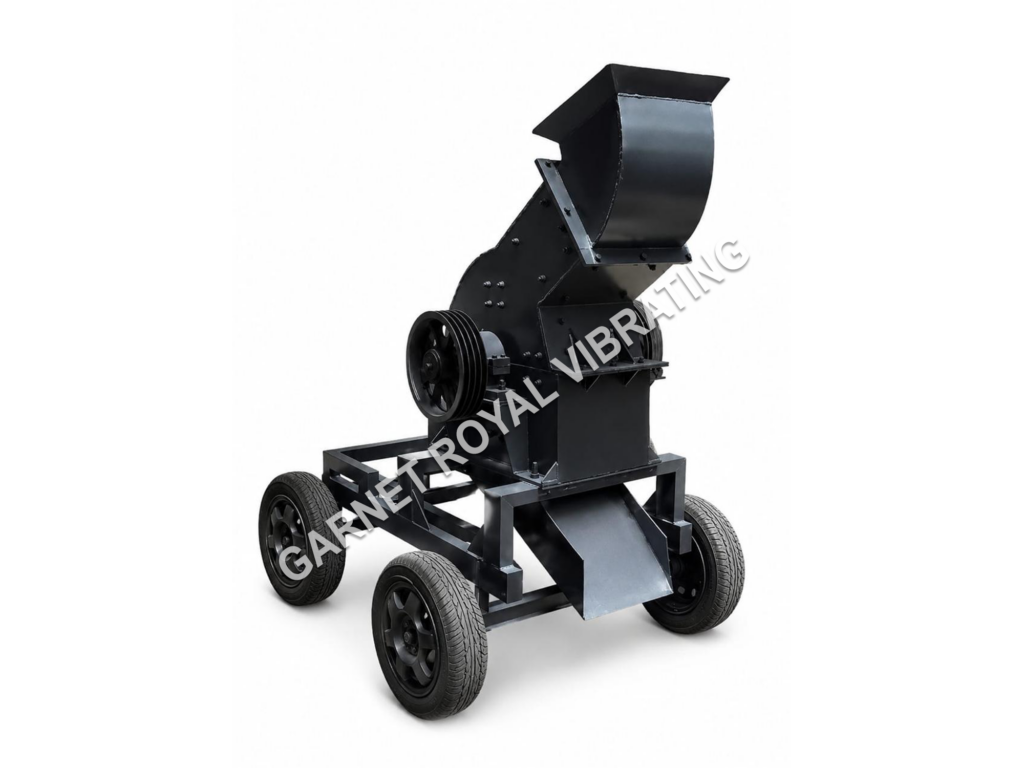
The Garnet Royal disintegrator carries out tertiary crushing of soft and medium-hard materials, whether non-abrasive or medium abrasive, by driving hammers against a liner plate at high speed. It works at a maximum crushing ratio of 10:1 and delivers output up to 60 mesh B.S.S., with capacities from 100 kg to 20 TPH. Construction is deliberately simple and sturdy, so the machine is easy to run and needs minimal maintenance.
Technical specifications
| Type | Disintegrator (impact hammer type) |
| Duty | Tertiary crushing of soft and medium hard materials |
| Suitable feed | Non-abrasive to medium abrasive materials |
| Crushing action | Impact of hammers against a liner plate |
| Crushing ratio | 10:1 maximum |
| Output fineness | Available up to 60 mesh B.S.S. |
| Capacity | 100 kg – 20 TPH |
| Max. feed size | Up to 50 mm (model dependent) |
| Rotor diameter | 400 – 1000 mm (model dependent) |
| Rotor speed | Approx. 900 – 1800 rpm, set by required fineness |
| Hammers | Hardened, reversible and replaceable |
| Liner plate | Wear-resistant, replaceable, adjustable clearance |
| Material of construction | Fabricated mild steel housing with alloy steel hammers and manganese steel liners |
| Drive | Direct or V-belt driven electric motor |
| Power supply | 415 V, 3-phase, 50 Hz (other supplies on request) |
| Maintenance | Hinged or split casing for access; minimum routine attention |
| Options | Feed hopper, screen classification, dust extraction hood, base frame |
Specifications are indicative and configured to your application. Share your material, feed size and required output for an exact model recommendation.
Key features
- Output available up to 60 mesh B.S.S. from suitably sized feed, within the 10:1 reduction ceiling.
- Crushing ratio up to 10:1 without an intermediate stage.
- Handles both non-abrasive and medium abrasive materials.
- Impact action leaves a loose, free-flowing product rather than a compacted cake.
- Reversible hammers and a replaceable liner plate keep wear costs predictable.
- Adjustable hammer-to-liner clearance to reset product size as hammers wear.
- Sturdy construction requiring minimum maintenance.
- Capacity from 100 kg per hour for small batch duty up to 20 TPH continuous.
Frequently asked questions
How fine is the output from a disintegrator?
Output is available up to 60 mesh B.S.S. Product size is governed by rotor speed, the clearance between the hammers and the liner plate, and any classifying screen fitted at the discharge. Coarser settings are straightforward; reaching the fine end of the range depends on the material being brittle and dry enough to keep fracturing under repeated impact.
What is the difference between a disintegrator and a hammer mill?
Both work by impact, but they occupy different stages. A hammer mill takes coarse feed on secondary and tertiary duty, handles harder ores and typically discharges through grate bars at a few millimetres. The disintegrator is a lighter tertiary machine, tuned to soft and medium-hard, non-abrasive to medium abrasive material, and reaches a considerably finer product at up to 60 mesh B.S.S.
Can it process abrasive materials?
It is rated for non-abrasive and medium abrasive feed. Medium abrasive material can be run, with the expectation of shorter hammer and liner life and a planned spares stock. Highly abrasive ores are outside the intended duty and will make wear cost dominate operating cost. Send us the mineral name or an abrasion index and we will confirm suitability before you order.
What maintenance does it need?
Very little. Routine attention comes down to bearing lubrication, checking hammer wear and resetting the liner clearance as the hammers shorten. Hammers are reversible and replaceable, and are always changed as a balanced set to keep the rotor running true. The casing opens for access, so a hammer change is a short job rather than a strip-down.