Impact Roll Crusher
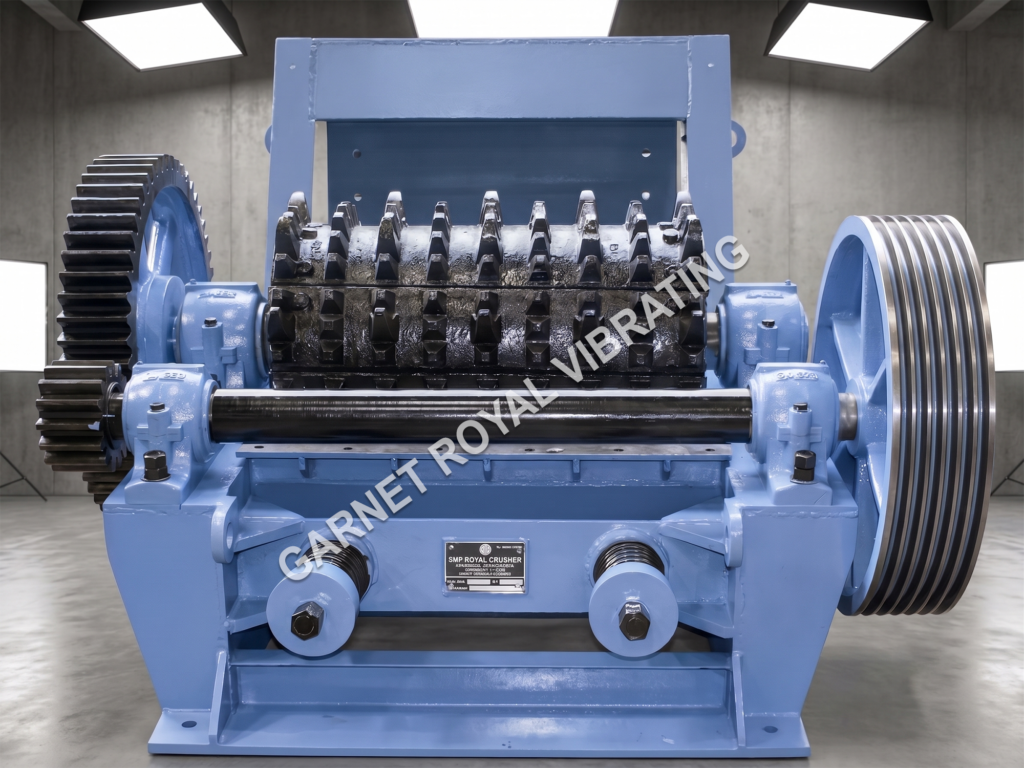
The impact roll crusher combines the controlled nip of a roll crusher with the higher breaking energy of an impactor. Material is drawn between profiled rolls running at raised peripheral speed and fractured along its natural cleavage planes, giving a greater reduction ratio than plain rolls and a better-shaped, more cubical product than a conventional impact crusher. Garnet Royal builds it for medium-hard, low-to-medium abrasive feed across a capacity range of 100 kg to 15 TPH.
Technical specifications
| Automatic | No |
| Product Type | Toothed Single Roll Crusher |
| Color | Client choice |
| Capacity | 5 ton – 50 Tph. |
| Computerized | No |
| Delivery Time | 45 days |
| Feature | Better efficiency |
| General Use | Soft Material Crushing |
| Main Market | All India, Nepal, Bhutan, Russia, Bangladesh, Zambia, Iraq, |
| Material | Steel casting, MN casting & others. |
| Minimum Order Quantity | 1 |
| Voltage | 400-420 Volts (v) |
Specifications are indicative and configured to your application. Share your material, feed size and required output for an exact model recommendation.
Frequently asked questions
How does it differ from a double roll crusher?
A double roll crusher squeezes material at low speed and is limited to a modest reduction ratio, typically 2.5:1 to 3:1. The impact roll crusher runs faster and adds an impact component at the nip, reaching up to about 8:1 in one stage. It produces more fines than a plain roll machine, but far fewer than a conventional impactor.
Why is product shape better than with an impactor?
In a conventional impactor, particles are struck repeatedly and at random while flying free, which rounds some and shatters others across a wide gradation. Here the particle is held at the nip and receives a controlled blow, so it fractures along its natural cleavage planes. The result is a more equidimensional, cubical fragment that satisfies aggregate flakiness limits.
How is the output adjusted?
Two settings work together. The roll gap fixes the top size of the product in the same way as any roll crusher, while rotor speed determines the energy per blow and therefore how much of the material falls below that top size. Opening the gap raises capacity; raising speed increases reduction and fines. Both can be changed on site.
Is it suitable for abrasive material?
It is intended for low to medium abrasiveness. The impact component that gives the machine its reduction ratio also accelerates wear on the bars and shells, so highly abrasive quartzitic rock, granite or chromite is better handled by a compression crusher such as a double toggle jaw. For limestone, dolomite, slag and recycled concrete, wear rates are reasonable.