
Tiger Mill (Three Roll Mill)
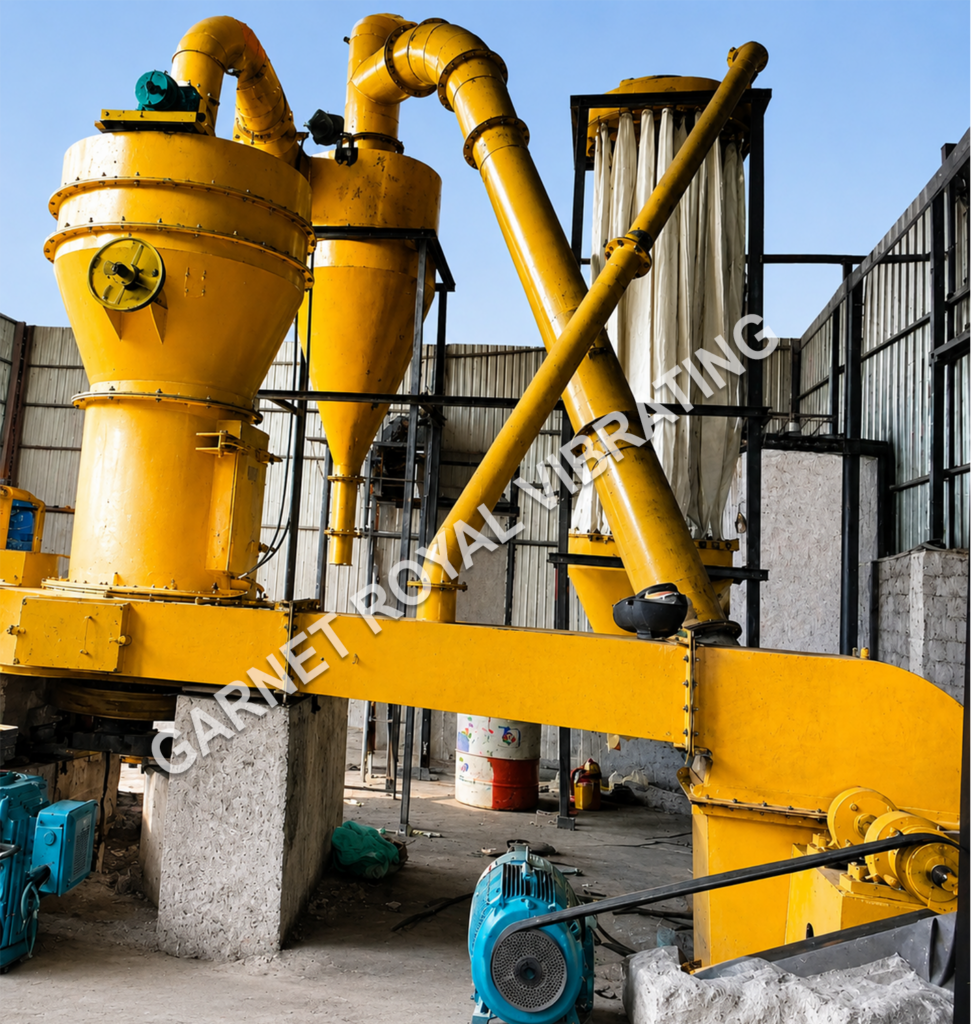
The Garnet Royal Tiger Mill — also supplied as a three roll grinding mill — performs tertiary fine grinding of soft, medium-hard and less abrasive minerals. Three heavy rolls travel around a grinding ring, reducing material by rolling pressure rather than impact, which yields a closely controlled powder across 80 – 225 mesh B.S.S. Capacities run from 1.5 TPH to 2 TPH on a 220 to 415 V supply.
Technical specifications
| Type | Three roll grinding mill (Tiger Mill), tertiary fine grinding |
| Product type | Grinding mill |
| General use | Grinding of soft, medium hard and less abrasive minerals |
| Capacity available | 1.5 TPH – 2 TPH |
| Product fineness | 80 – 225 mesh B.S.S. |
| Grinding action | Rolling pressure of three rolls against a grinding ring |
| Classification | Integral classifier with coarse return for regrinding |
| Voltage | 220 – 415 V |
| Power supply | 3-phase, 50 Hz, low power consumption for economical operation |
| Drive | High performance electric motor through belt transmission — smooth and noiseless |
| Automation grade | Semi-automatic |
| Material of construction | Cast iron with high tensile strength for long service life |
| Wear parts | Replaceable rolls and grinding ring |
| Feature | High efficiency, steady power draw, low noise |
| Options | Cyclone and bag filter, feeder, blower, base frame |
Specifications are indicative and configured to your application. Share your material, feed size and required output for an exact model recommendation.
Key features
- Closely controlled product across 80 – 225 mesh B.S.S., set at the classifier.
- Fineness held by classification, not by grinding time, so output stays consistent across a shift.
- Rolling pressure action — lower noise and steadier power draw than impact milling.
- Belt transmission drive gives smooth, noiseless running and damps shock loads.
- High-tensile cast iron construction for extended service life.
- Low power consumption for economical operation at 220 – 415 V.
- Replaceable rolls and grinding ring with wear spread over the full circumference.
- Continuous production capacity of 1.5 – 2 TPH.
Frequently asked questions
How fine can the Tiger Mill grind?
Output fineness spans 80 to 225 mesh B.S.S. across the normal range of soft and medium-hard minerals. Fineness is set by the integral classifier rather than by how long material spends in the grinding zone, which keeps the product consistent even as feed rate varies slightly through a shift.
Which materials suit a three roll grinding mill?
It is designed for soft, medium-hard and less abrasive minerals. Typical feeds include bauxite, china clay, coal, coke, limestone, soapstone, herbs and spices. Hard and strongly abrasive ores are outside the intended duty, as they wear the rolls and grinding ring rapidly and make wear cost dominate the economics of the installation.
What capacity and power supply does it need?
Capacities available run from 1.5 TPH to 2 TPH. The motor runs on a standard alternating supply of 220 to 415 V, and power consumption is low for the output, which keeps running cost economical.
Why choose roller grinding over impact milling?
Rolling pressure applies energy gradually within a bed of material instead of in violent single blows. That produces less noise, a steadier load on the drive and a narrower product size band with fewer uncontrolled fines. Combined with belt transmission and classifier-controlled fineness, it makes the mill well suited to filler and extender grades where consistency matters more than raw reduction ratio.