
Double-Pan Muller Mixer
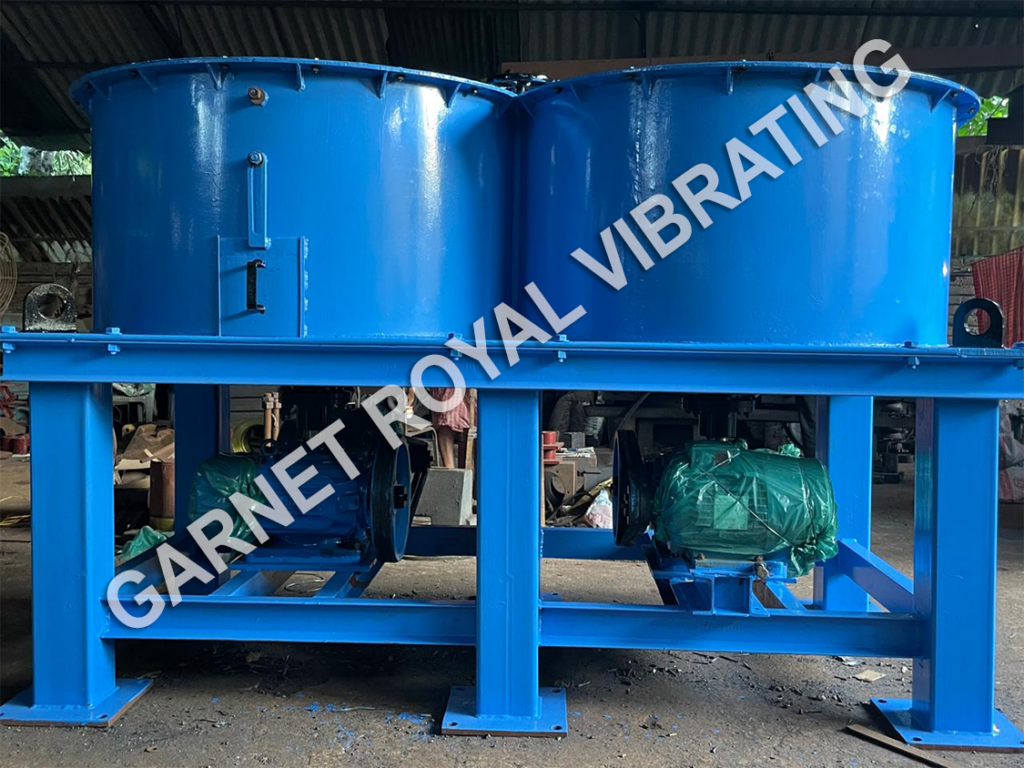
The Garnet Royal double pan muller mixer handles homogeneous mixing of solids with liquids in continuous mode, at throughputs a single pan cannot sustain. Two pans work in series, driven by multiple ploughs and, on specific processes, by ploughs and mullers together. Rated at 10 TPH to 30 TPH on chromite ore, the machine discharges through sequenced pneumatic gates and is built for the sintering, pelletising and briquetting duties that run continuously around the clock.
Technical specifications
| Type | Plough-Muller Mixer |
| Automatic | No |
| Capacity | 100kg -10Tph. |
| Color | Blue |
| Delivery Time | 45 Days |
| Computerized | No |
| Feature | High Efficiency |
| Main Market | All India, Nepal, Bhutan, Russia, Bangladesh, Zambia, Iraq, |
| Material | Steel |
| Type | Fines Mixer |
| Minimum Order Quantity | 1 |
| Sample Available | Yes |
| Machine weight | 4 – 5 Ton. |
| Voltage | 400-420 Volt (v) |
Frequently asked questions
Why use two pans instead of one larger one?
Enlarging a single pan increases capacity but does nothing about short-circuiting, where part of the feed crosses the pan faster than the rest and leaves under-mixed. Two pans in series give the material a second, independent pass, so the spread of residence times narrows sharply. It also lets you set a different tool arrangement and speed in each stage, distributing binder first and conditioning second.
How do I choose between pan, paddle and ribbon mixing?
Pan mixing gives the highest intensity and is the right answer for heavy, abrasive ore that needs binder worked into it. A twin-shaft paddle mixer is faster and gentler and suits free-flowing solids at high tonnage where you need throughput rather than shear. A ribbon blender is a batch machine for dry powders where particle integrity matters and no liquid is added.
Can the discharge be matched to our downstream equipment?
Yes. The pneumatic gates open in a sequence the operator configures, so the flow leaving the mixer can be tuned to a briquetting press, a balling disc or a sinter strand. Where the plant already has a control system, the mixer panel can be interlocked with it so that a downstream stoppage holds the bed rather than spilling a part-mixed charge.
What throughput will I get on a material other than chromite?
The 10 TPH to 30 TPH rating is stated on chromite ore because it is a dense, well-characterised reference feed. A lighter material fills the same pan volume at a lower mass, so tonnage falls roughly in proportion to bulk density. Send us your bulk density, moisture and target mixing time, and we will confirm the achievable rate before quoting.