Hammer Mill (Hammer Crusher)
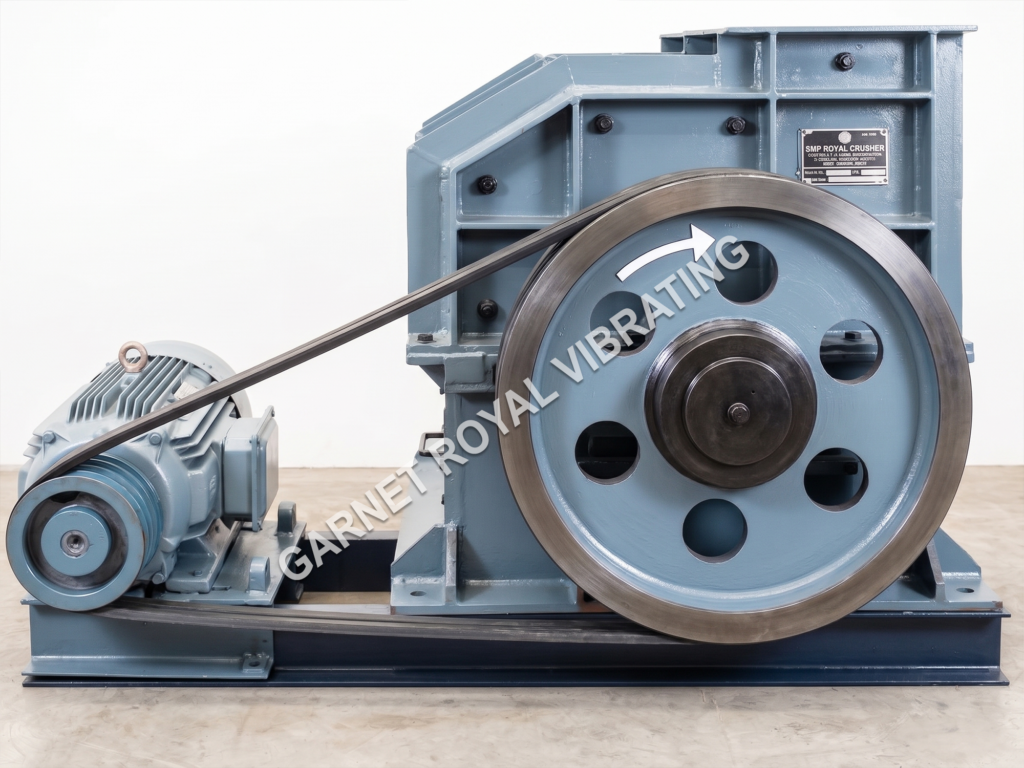
The Garnet Royal hammer mill, also supplied as a swing-hammer crusher, reduces ores and minerals in a single pass using free-swinging hammers on a high-speed rotor. It covers secondary and tertiary duties on coal, coke, iron ore, limestone and gypsum at a normal crushing ratio of 10:1, with product available down to 3 mm. Each machine is built at our Howrah works and configured with either a bottom grate bar discharge or an open bottom discharge.
Technical specifications
| Type | Swing hammer mill / hammer crusher |
| Duty | Secondary & tertiary crushing of ores and minerals |
| Crushing action | Impact of a series of rotating swing hammers against a spring-loaded breaker plate |
| Crushing ratio | 10:1 (normal) |
| Capacity | 100 kg – 50 TPH |
| Output size | Available down to 3 mm |
| Max. feed size | Up to 200 mm (model-dependent) |
| Discharge arrangement | Bottom grate bar discharge or open bottom discharge |
| Rotor diameter | 400 – 1200 mm (model dependent) |
| Rotor speed | Approx. 750 – 1500 rpm, set by required fineness |
| Hammers | Hardened alloy steel, reversible and replaceable |
| Grate bars & liners | Wear-resistant, interchangeable to change product size |
| Material of construction | Fabricated mild steel housing, alloy steel hammers, manganese steel liners |
| Drive | V-belt or direct-coupled electric motor |
| Power supply | 415 V, 3-phase, 50 Hz (other supplies on request) |
| Options | Feed hopper, base frame, dust hood with extraction connection, rotor balancing certificate |
Specifications are indicative and configured to your application. Share your material, feed size and required output for an exact model recommendation.
Key features
- Reduction ratio of about 10:1 achieved in a single pass, removing an intermediate crushing stage.
- Choice of bottom grate bar or open bottom discharge to suit dry or damp feed.
- Spring-loaded breaker plate protects the rotor from tramp metal and uncrushables.
- Reversible hammers — turned end for end at half-life to double service between changes.
- Interchangeable grate bars set product size without altering the rotor.
- Split or hinged casing for quick access to hammers, pins and liners.
- Dynamically balanced rotor for low vibration and steady bearing temperatures.
- Capacity band from 100 kg per hour pilot duty up to 50 TPH plant duty.
Frequently asked questions
What output size can a hammer mill achieve?
The product is available down to 3 mm when the mill is fitted with bottom grate bars, because only particles finer than the bar opening can leave the chamber. Coarser settings are simply a matter of changing the grate. With an open bottom discharge the size band is wider and coarser, since material leaves after a single pass rather than being recirculated to size.
What is the difference between grate bar and open bottom discharge?
Grate bars retain oversize inside the crushing chamber until it is small enough to pass, giving a closely controlled top size at the cost of extra recirculation and power. An open bottom lets material fall away as soon as it is broken. Choose grate bars for a defined product, and an open bottom for damp, sticky or very high tonnage feed where blinding is a risk.
How often do the hammers need changing?
Hammer life depends almost entirely on the abrasiveness of the feed rather than on tonnage alone. Limestone and coal are gentle; iron ore and quartz-bearing material are not. Our hammers are reversible, so at half life they are turned end for end to expose a fresh striking face, which typically doubles the interval between replacements. Always change hammers as a balanced set.
Can the mill handle tramp metal?
The swinging hammer mounting and the spring-loaded breaker plate both give way under shock, so an occasional uncrushable piece passes through instead of stalling the rotor. That is protection, not immunity. We recommend a magnetic separator or grizzly ahead of the inlet on ore and recycled feed, which extends hammer, pin and liner life considerably.