
Rotary (Trommel) Screen
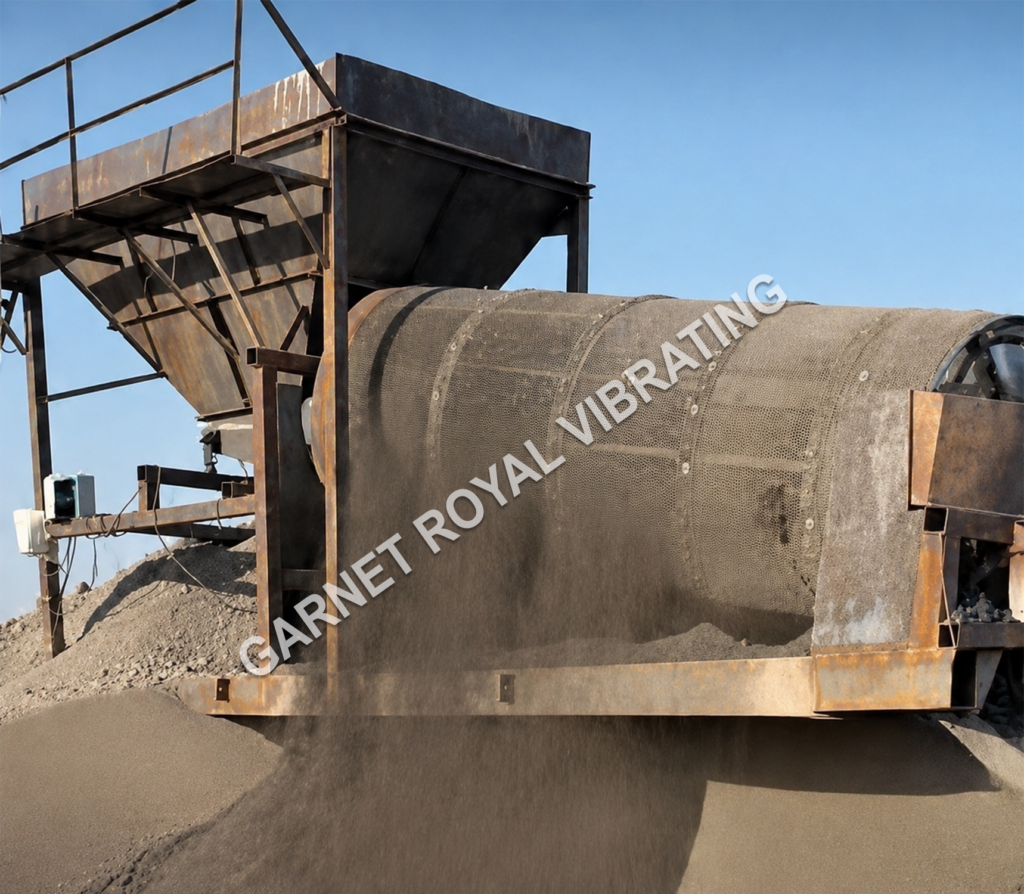
The Garnet Royal rotary screen, also known as a rotary drum screen, grades bulk material inside a slowly turning drum built in hexagonal, conical or cylindrical form and driven by a motorised gearbox. Material tumbles the length of the drum while undersize passes through the perforations, giving multiple size separation in a single pass at rates up to 30 TPH. An optional washing section cleans aggregate as it grades, and a gyratory-motion variant covers super-fine cuts below 3 mm.
Technical specifications
| Machine type | Rotary Screen |
| Automatic | No |
| Capacity | 500-2000 Kg/hr |
| Computerized | No |
| Colour | Blue |
| Delivery Time | 1 Day |
| Feature | High Efficiency |
| Main Domestic Market | All India |
| Material | Cast Iron, Other |
| Minimum Order Quantity | 1 |
| Supply Ability | 10 Per Day |
| Supply voltage | 400 – 420 volts |
| Weight (kg) | 4-5 Tonne |
Specifications are indicative and configured to your application. Share your material, feed size and required output for an exact model recommendation.
Key features
- Hexagonal, conical and cylindrical drums to suit free-flowing, lumpy or agglomerating feeds.
- Motorised gearbox drive with no eccentric shaft or out-of-balance loads on the structure.
- Multiple size separation in one pass, with sectioned or nested apertures.
- Gentle tumbling action that grades friable material without degrading it.
- Handles damp, sticky and irregularly shaped material that would blind a vibrating deck.
- Anti-blinding elements and an optional spray-bar washing section.
- M.S. or S.S. body construction, with GMP standard builds for food and pharmaceutical duties.
- Low noise, low speed and long media life, with interchangeable drum panels for fast aperture changes.
Frequently asked questions
When should I choose a trommel over a circular or linear motion screen?
Choose a trommel for wet, sticky, fibrous or irregular material that blinds a vibrating deck, and where gentle handling of friable product matters. Choose a circular motion screen for dry, free-flowing feeds at high tonnage on an inclined deck, and a linear motion screen for flat, low-headroom installations and dewatering. Trommels also run quietly and impose no vibrating loads on the supporting structure.
How fine a separation can a rotary screen make?
The drum’s finest accurate cut is around 3 mm. On dry fine-screening duty it grades material up to that size reliably, with output in the order of 500 to 2000 kg/hr. Separations below 3 mm are made on the gyratory motion variant instead, since its circular decks on multiple springs give a much longer travel path over the mesh.
What stops the apertures blinding?
The tumbling and cascading action of the drum keeps the bed moving and the surface largely self-clearing, and a hexagonal profile adds a drop at each transition that dislodges lodged particles. On fine-mesh and gyratory builds we fit anti-blinding elements — bouncing balls, sliders or ultrasonic deblinding — and external brushes or spray bars can be added for persistently sticky material.
Is a hygienic or GMP version available?
Yes. Body construction is offered in M.S. or S.S., and machines can be built to GMP standard for food, spice and pharmaceutical duties. Hygienic builds use stainless steel contact parts, crevice-free welds, polished surfaces and food-grade seals so the machine can be stripped and cleaned between batches. Please confirm the standard required when you enquire.