
Mineral Crusher
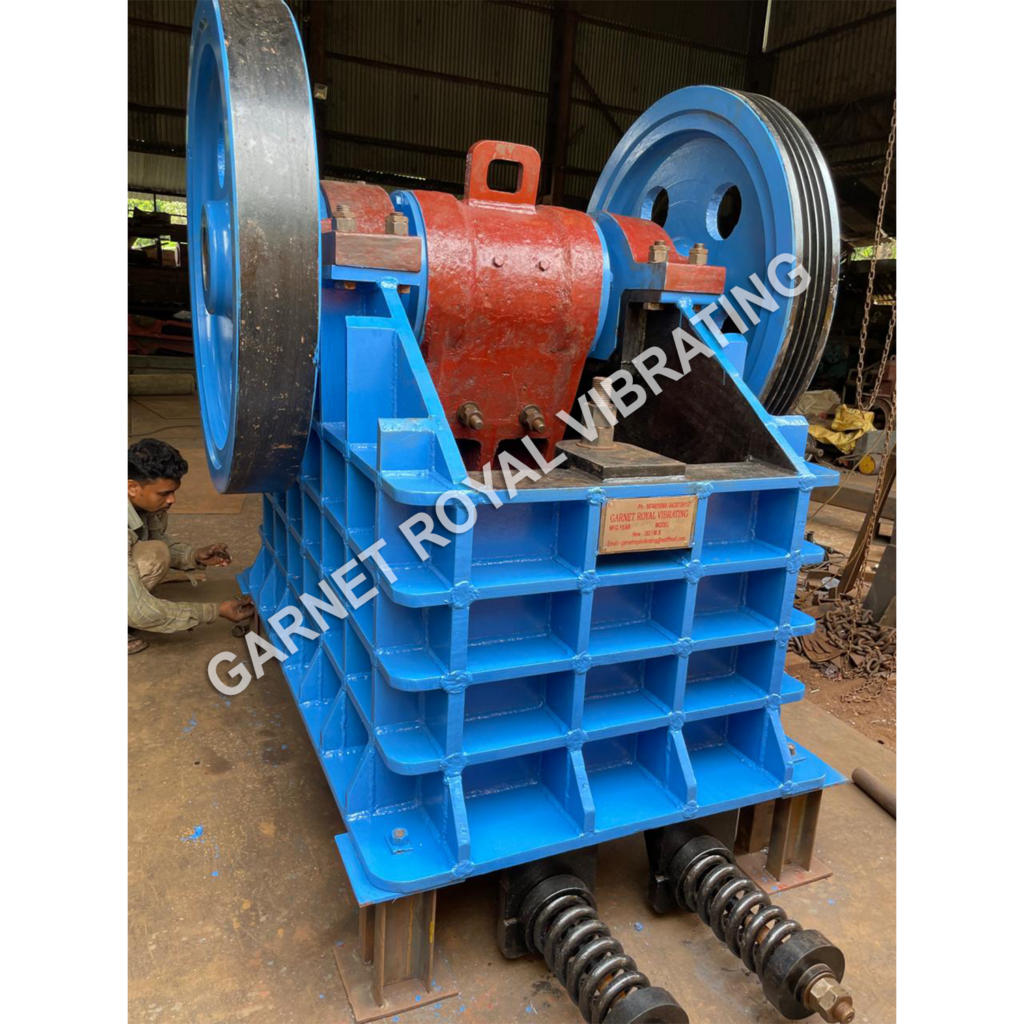
A mineral crusher is a jaw crusher set up for a job quite unlike quarrying. Here the rock is not the product; it is the carrier of a valuable mineral, and every choice in the machine is made to deliver that mineral to the next stage clean and at the right size. Garnet Royal supplies it for ore preparation and liberation ahead of grinding, gravity separation or flotation, handling quartz, feldspar, calcite, limestone, iron ore, chromite and bauxite at a normal crushing ratio of 6:1 in configurations covering 100 kg – 100 TPH. The range runs from a 270 kg laboratory unit used for sample preparation up to continuous plant machines feeding a mill.
Technical specifications
| Automatic | No |
| Product Type | Jaw Crusher |
| Color | Client choice |
| Capacity | 100 kg to 20 TPH |
| Computerized | No |
| Delivery Time | 45 days |
| Feature | Better efficiency |
| General Use | Crushing |
| Main Export Market(s) | Nepal, Bhutan, Russia, Bangladesh, Zambia, Iraq, |
| Main Shaft Speed | 12-16 r/min |
| Material | Steel casting, MN casting & others. |
| Minimum Order Quantity | 1 |
| Capacity Weight (kg) | 500 kg to 200 TPH |
| Voltage | 380 V / 415 Voltage |
Specifications are indicative and configured to your application. Share your material, feed size and required output for an exact model recommendation.
Frequently asked questions
How does a mineral crusher differ from a stone crusher?
The linkage is the same but the priorities are opposite. A stone crusher is set up to maximise graded tonnage from abrasive quarry rock, and fines are saleable. A mineral crusher is set up to reach liberation size with the least possible fines, holds a tighter and more precisely verified setting, and offers liner metallurgy chosen so the machine does not contaminate the material it is crushing.
Will the crusher contaminate my sample or product?
Standard manganese liners add traces of manganese and iron, which is harmless for most plant duties but not for assay work, high-purity quartz and feldspar, or circuits with magnetic separation. For those we supply chrome-molybdenum, hardened tool steel or tungsten carbide faced jaw plates, and the chamber is built to be cleaned down between batches so one sample does not carry into the next.
Can it produce a 0.5 mm to 6 mm product?
A jaw crusher will reach roughly 6 mm on the smallest models, but no jaw crusher will take material reliably down to 0.5 mm; the chamber geometry simply will not close that far. Where a 0.5 mm fraction is required, the jaw crusher is followed by a roll crusher or a pulveriser, and we will quote the two stages together so the split between them is sensible.
How do I keep fines to a minimum?
Run the crusher in closed circuit with a screen so material already at size is taken out before it can be crushed again, use a regulated feed rather than choke feeding, and resist the temptation to close the setting further than the circuit needs. Checking the closed side setting regularly with a lead cast matters too, because liner wear opens the setting and tempts operators to over-correct.