Stone Crusher
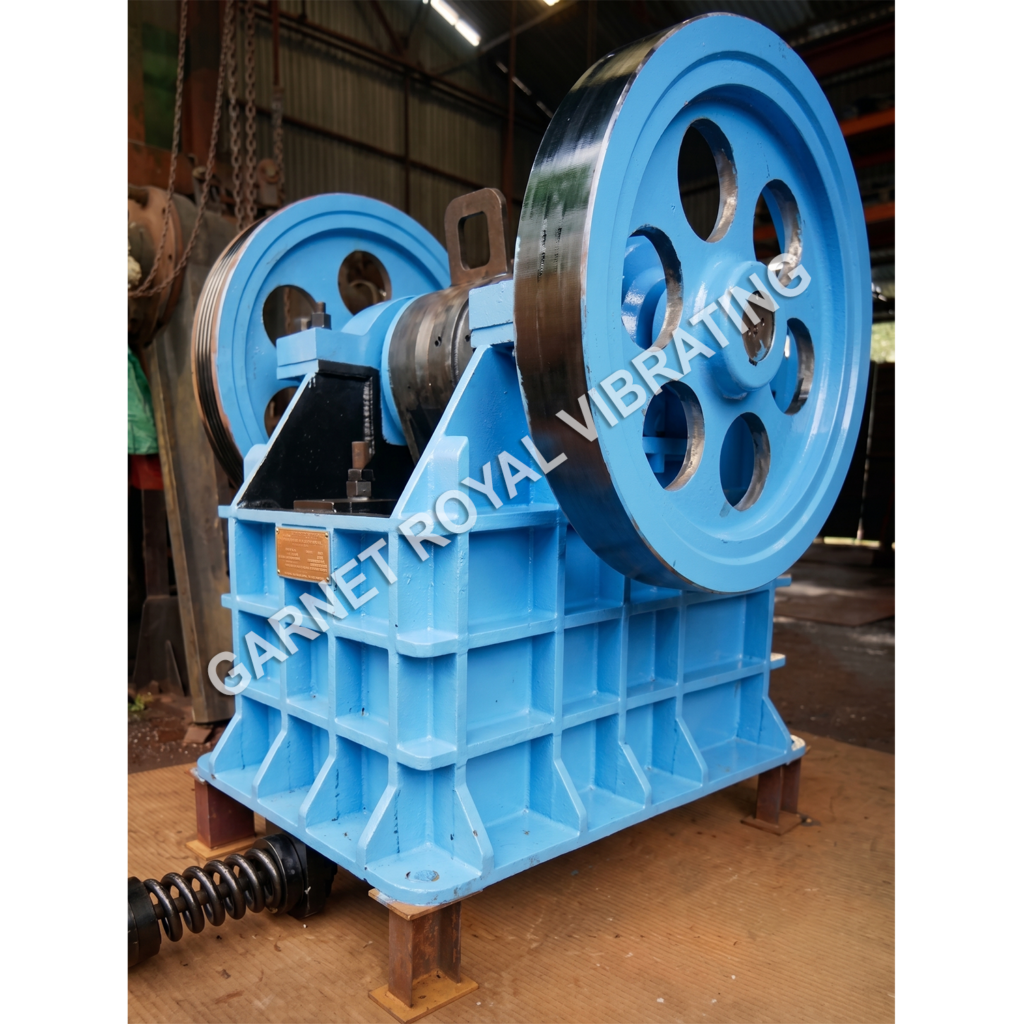
“Stone crusher” is the name most quarry and aggregate operators give to the jaw crusher that stands at the head of the plant, taking blasted rock or dredged boulder straight from the tipping hopper. Garnet Royal supplies it as a jaw crusher configured specifically for quarry duty on hard, abrasive stone—granite, basalt, trap rock, quartzite, and river boulder—at a normal crushing ratio of 6:1 and in configurations covering 100 kg – 100 TPH. The mechanism is a familiar jaw, but the wear package, chamber profile, and drive are all specified around a single objective: turning out consistent, well-graded aggregate shift after shift without the liner bill running away.
Technical specifications
| Automatic | No |
| Product Type | Jaw Crusher |
| Color | Client choice |
| Capacity | 100 kg to 100 TPH |
| Computerized | No |
| Delivery Time | 45 days |
| Feature | Better efficiency |
| General Use | Crushing |
| Main Export Market(s) | Nepal, Bhutan, Russia, Bangladesh, Zambia, Iraq, |
| Main Shaft Speed | 12-16 r/min |
| Material | Steel casting, MN casting & others. |
| Minimum Order Quantity | 1 |
| Capacity Weight (kg) | 500 kg to 200 TPH |
| Voltage | 400-420 Volts (v) |
Specifications are indicative and configured to your application. Share your material, feed size and required output for an exact model recommendation.
Frequently asked questions
Is a stone crusher the same thing as a jaw crusher?
Mechanically, yes — a stone crusher in an aggregate plant is a jaw crusher. The difference is how it is specified. This machine is configured for quarry stone: higher manganese liner grades, a coarser corrugation at the feed end, a chamber suited to choke feeding, and dust control at the discharge. A crusher built for ore or slag duty would be specified quite differently even though the linkage looks identical.
How large a boulder can it take?
Roughly 80% of the gape. On the 1000 mm gape machine that is about 800 mm; on a 600 mm gape it is about 480 mm. Feeding closer to the full gape than that causes bridging at the top of the chamber, and the operator ends up rocking the feeder to clear it, which costs more tonnage than it saves.
Which liner grade should I specify for granite?
For granite, quartzite and other high-silica stone we normally recommend 18% or 22% manganese rather than the standard grade, because the higher alloy resists gouging wear better where the feed is too small to work-harden a plain manganese surface fully. Where the stone is severely abrasive but the lumps are modest, chrome-molybdenum inserts often give the lowest cost per tonne crushed.
How do I get several aggregate sizes from one crusher?
By closing the crusher onto a screen. The crusher discharge feeds a multi-deck screen, each deck drops a saleable fraction, and the oversize is returned to the crusher feed. Setting the crusher to the coarsest fraction you sell and letting the recirculating load do the rest gives the best balance of tonnage and liner life.