
Bucket Elevator
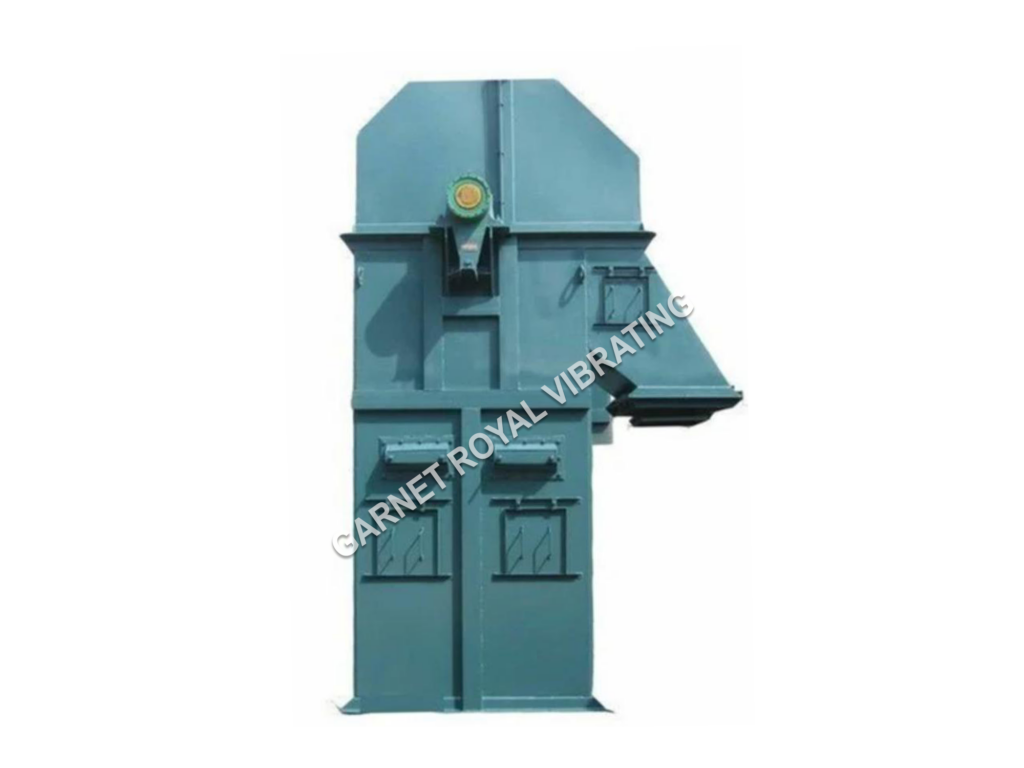
The Garnet Royal bucket elevator raises bulk material vertically inside a fully enclosed casing, using buckets bolted to an endless belt or chain. Material is scooped up at the boot, carried to the head and thrown clear into the discharge spout. Where floor space is scarce and the lift is high, it moves far more tonnage per kilowatt than any inclined conveyor, with almost no spillage or dust escape.
Technical specifications
| Type | Type |
| Mechanism type | Belt & bucket, or single & double strand chain |
| Material | Stainless Steel |
| Capacity | Approx. 5 – 200 TPH |
| Drive Type | AC |
| Bucket material | Pressed steel, stainless steel, HDPE, or nylon |
| Delivery Time | 45 Days |
| Voltage | 220 Volts (v) |
| Main Market | All India, Nepal, Bhutan, Russia, Bangladesh, Zambia, and Iraq. |
| Safety Device | Emergency Lowering, Overload Holding Stop |
| Finish | Shot blasted, primed & painted, or stainless steel left unpainted |
Specifications are indicative and configured to your application. Share your material, feed size and required output for an exact model recommendation.
Key features
- High lift in a very small footprint, with low power per tonne raised.
- Belt or chain traction is selected on capacity, lump size, and temperature.
- Centrifugal or continuous discharge to protect friable products.
- Dust-tight bolted casing with sealed inspection and service doors.
- Head-shaft backstop and overload holding stop as standard protection.
- Controlled emergency lowering to clear a stalled or jammed leg safely.
- Boot take-up with a self-cleaning pulley to stop material packing beneath it.
- Stainless steel construction is available for food, pharma, and corrosive duties.
Frequently asked questions
Belt or chain—which should I choose?
Belt-and-bucket elevators run faster and quieter, cost less, and suit free-flowing material such as grain, sand, or pellets at ambient temperature. Chain legs handle larger lumps, hot material, and heavy abrasives that would cut or burn a rubber belt, and they cope better with material that packs into the boot. Temperature, lump material, and abrasiveness usually decide the question.
What safety devices are supplied with the elevator?
Standard protection comprises a head-shaft backstop to prevent reverse running of a loaded leg, an overload holding stop that trips the drive before a jam damages the belt or chain, and a controlled emergency lowering facility. Belt-slip, misalignment, bearing-temperature, and boot-level sensors are added where duty, dust class, or plant standards call for them.
How high can a single elevator lift?
We build single legs to around 40 meters, which covers the great majority of silo, mill, and process building duties. The governing constraints are belt or chain working tension, the stiffness of the casing against wind and material load, and the practicality of erection. Taller lifts are handled by two legs in series with an intermediate transfer.
Will the elevator damage fragile material?
A centrifugal machine throws each load across the casing, which can break malt, pulses, extruded pellets, or coated granules. Specify continuous discharge instead: the leg runs slowly with closely pitched buckets, and each load slides gently over the back of the bucket ahead into the spout. Product degradation falls sharply at the cost of a slower belt.