
Screw Feeder / Screw Conveyor
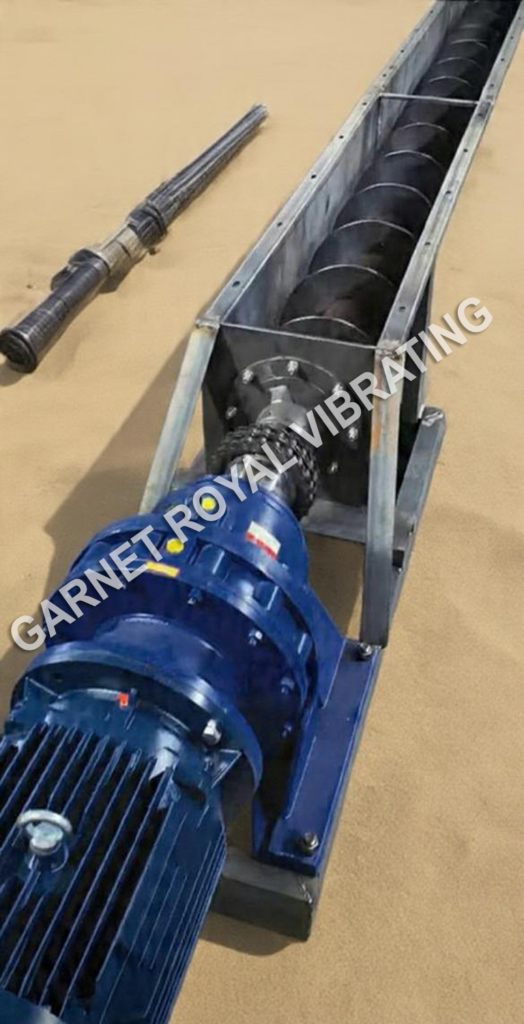
The Garnet Royal screw machine moves powders, granules and other dry bulk solids using a rotating helical flight running inside a U-trough or closed tube, and is supplied in two duties. As a screw conveyor it carries material along a horizontal or inclined path between two points in the process; because the casing is sealed over its full length, product travels without dust escape or contamination, and the same machine can meter, blend, cool or heat it on the way. As a screw feeder it is fitted directly under a hopper or silo outlet and runs flood-loaded, metering tonnage out of the vessel by screw speed.
Technical specifications
| Type | Screw & auger conveyor — U-trough or tubular, shafted or shaftless |
| Screw diameter | 150 – 600 mm |
| Capacity | Approx. 1 – 10 TPH |
| Screw speed | 10 – 25 rpm, fixed or variable |
| Trough loading | 15 – 45 per cent of cross-section by material class |
| Inclination | 0 – 20° standard |
| Material of construction | Mild steel to IS 2062, or stainless steel 304 & 316 |
| Bearing & hanger housings | Cast iron, with gland or labyrinth end seals |
| Drive type | AC geared motor, direct, chain or belt coupled |
| Motor rating | 1.5 – 30 kW to suit length, loading & density |
| Supply voltage | 400 – 420 V, three phase, 50 Hz |
| Finish | Sand blasted, primed & painted. |
Specifications are indicative and configured to your application. Share your material, feed size and required output for an exact model recommendation.
Key features
- Fully enclosed casing gives dust-free, contamination-free transfer.
- A U-trough or tubular casing and a shafted or shaftless screw to suit the material.
- Hard-faced or abrasion-resistant flights and replaceable trough liners for gritty duties.
- Variable-speed drive turns the conveyor into an accurate volumetric feeder.
- Jacketed barrel option for heating, cooling or drying material in transit.
- Multiple inlets and outlets with manual or pneumatic slide gates.
- Gland, labyrinth or purged end seals to keep fines out of the bearings.
- Mild steel, stainless steel or food-contact finishes on the same frame design.
Frequently asked questions
What is the steepest angle a screw conveyor can work at?
Standard trough units are quoted to 20 degrees, where roughly a third of the horizontal capacity is lost to fall-back over the flight. With a tubular casing, reduced pitch and higher speed we supply screws up to about 45 degrees, though the derating is close to half. Above that, a bucket elevator gives better power economy for the same lift.
Should I specify a shafted or a shaftless screw?
Shafted screws are the default for dry, free-flowing powders and granules, and they cost less over long runs. Choose a shaftless spiral for sticky, fibrous, stringy or lumpy material — sludge, wet cake, waste and vegetable matter — because there are no hanger bearings in the flow path to catch material or to wear out in the product stream.
Can the conveyor also meter material into a process?
Yes. Fitted with a variable-frequency drive and a flood-fed inlet, the screw becomes a volumetric feeder, since discharge is closely proportional to rotational speed. Adding load cells under the hopper converts it to a loss-in-weight feeder for gravimetric dosing. Short-pitch or variable-pitch flights near the inlet help draw material evenly across the full opening.
How do you handle hot or highly abrasive material?
Hot duties use heat-resistant steel, expansion allowance in the casing and bearings mounted outboard of the seal, away from the product. Abrasive duties combine hard-faced or bolted wear-strip flights, replaceable liner plates in the trough bottom, generous flight thickness and a low screw speed. Both options are engineered case by case from your material data.