Twin-Paddle “U” Mixer
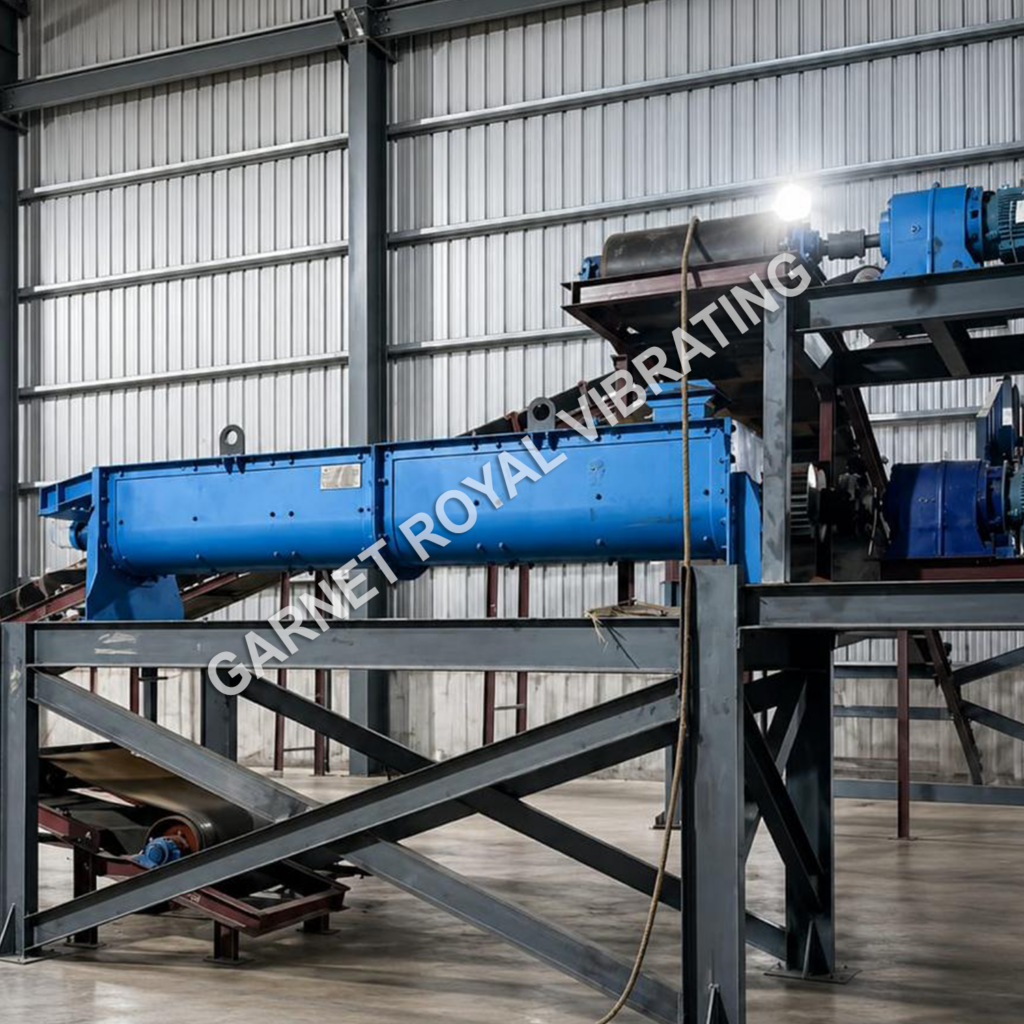
The Garnet Royal twin-shaft paddle mixer — known across the Indian process industry as the twin paddle ‘U’ mixer after its U-shaped trough — blends solids with solids or solids with liquids in continuous mode. Helix paddles on counter-rotating shafts throw material through a shared central zone, giving fast homogeneity at short residence times. Light-duty builds run 2 TPH to 20 TPH; heavy-duty builds run 5 TPH to 50 TPH on abrasive feeds.
Technical specifications
| Type | Twin Paddle U Mixer |
| Automatic | No |
| Capacity | 100 kg -20 Tph. |
| Color | Blue |
| Delivery Time | 45 day |
| Computerized | No |
| General Use | Mixing |
| Feature | High Efficiency |
| Main Market | All India, Nepal, Bhutan, Russia, Bangladesh, Zambia, Iraq. |
| Material | Steel |
| Type | Mixer |
| Minimum Order Quantity | 1 |
| Sample Available | Yes |
| Machine weight | 4 – 5 tonne |
| Voltage | 400-420 Volt (v) |
| Drive through | Gear motor |
Frequently asked questions
Is this the same as a twin-paddle ‘U’ mixer?
Yes. Twin-shaft paddle mixer, twin paddle ‘U’ mixer and U-trough paddle mixer all describe the same machine: two counter-rotating shafts carrying helix paddles inside a U-shaped trough. The ‘U’ refers to the trough cross-section, which lets the paddles sweep close to the wall so there is no dead material sitting in the corners of the vessel.
Solid trough or diaphragm trough – which do I need?
A solid trough is a single fabricated shell and is the right choice for light applications on soft, less abrasive materials. A diaphragm trough carries a replaceable liner system that absorbs the wear and is specified for heavy or highly abrasive feeds such as ore and slag. The extra cost is recovered in wear-part changes that take a shift rather than a shutdown.
How do I choose between pan, paddle and ribbon mixing?
Paddle mixing is the continuous, high-throughput option and suits free-flowing solids that need blending quickly. Pan mixing is batch and intensive and is the choice where a liquid binder must be worked into heavy or abrasive material. A ribbon blender is a gentle batch machine for dry powders and light granules where minimising particle damage matters more than speed.
Can it run in batch mode as well?
It can. Fitting a discharge gate instead of an open spout lets the trough be filled, mixed for a set time and then emptied, which is useful where recipes change frequently or batch records are required. Throughput drops because the fill and empty time is added to every cycle, so if the plant genuinely runs continuously, the open-flow arrangement is the better engineering choice.