
Reciprocating Plate Feeder
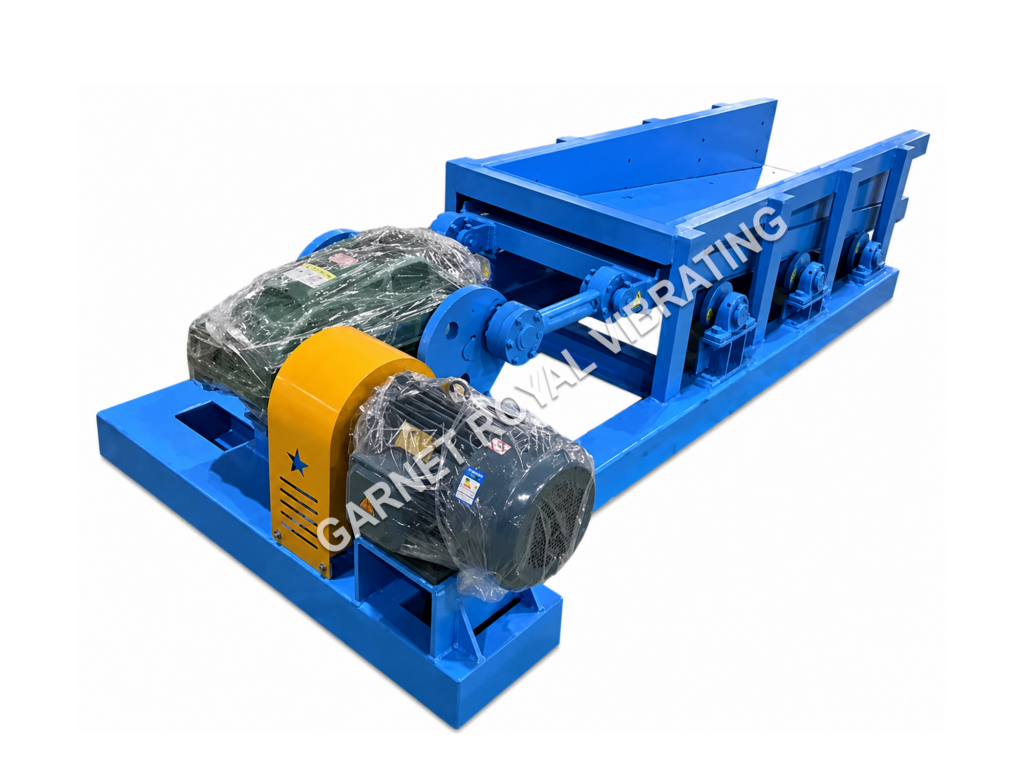
A reciprocating plate feeder draws heavy rock from a service hopper and delivers it to a crusher or conveyor by sliding a steel plate back and forth beneath the outlet. The motion is slow, positive and mechanically driven, so the machine keeps working under a deep column of dense, lumpy or sticky material that would stall a vibrating feeder. Garnet Royal builds these units – also known simply as a reciprocating feeder – for run-of-mine duty in mines, quarries and heavy process plants.
Technical specifications
| Machine type | Reciprocating plate feeder |
| Duty | Rated feeding of heavy rock from service hoppers to crushers or conveyors by reciprocating motion |
| Drive | Geared motor with crank or eccentric shaft and connecting rod |
| Motor supply | 3-phase, 400 – 420 V, 50 Hz |
| Capacity, full range | Approx. 20 – 100 TPH |
| Maximum feed lump | Up to 600 mm on wide-plate models; proportionally smaller on narrower plates |
| Plate width | 600 – 1,800 mm |
| Stroke length | 50 – 200 mm, adjustable at the eccentric |
| Stroke rate | 10 – 40 strokes per minute, VFD adjustable |
| Rate control | Stroke length and stroke frequency; cut-off gate for coarse trimming |
| Material of construction | Fabricated mild steel frame; wear-resistant steel plate and replaceable liners |
| Plate support | Rollers or slide rails with sealed, greasable bearings |
| Automation | Manual or VFD control is standard; PLC interlocking with the crusher optional |
| Machine weight | 4 – 5 tonne |
Specifications are indicative and configured to your application. Share your material, feed size and required output for an exact model recommendation.
Frequently asked questions
What is the difference between a feeder and a conveyor?
A conveyor receives material at a chute and transports it; it cannot; otherwise,ow much leaves the bin. A feeder sits uopening,e hopper outlet, carries the load of the material column and meters the discharge. This machine is a feeder in the strictest sense, because each stroke removes a measured slice regardless of the head above it.
When should I choose this over a vibrating feeder?
Choose the reciprocating plate feeder for very large lumps, high bulk density, deep hopper heads, and damp or clay-bearing feed. A vibrating feeder relies on throwing the bed forward, which becomes inefficient with heavy or sticky material. Where the feed is dry, free-flowing and moderately sized, the vibrating machine is lighter and cheaper to run.
How is the stroke adjusted?
The connecting rod is repositioned on the eccentric or crank disc, which changes the throw and therefore the thickness of material taken per cycle. This is a planned, offline adjustment. Routine rate changes during production are made instead by varying the motor speed, and the cut-off gate provides a coarse setting for a change of material.
Which parts wear out, and how are they replaced?
The plate face, the hopper lip liner and the skirt seals take the wear. All are bolted rather than welded, so they can be changed in place without disturbing the drive train or the frame. Rollers and bearings are sealed and greasable,drivetrainarbox and eccentric are accessible from outside the material path.