Tripper Conveyor
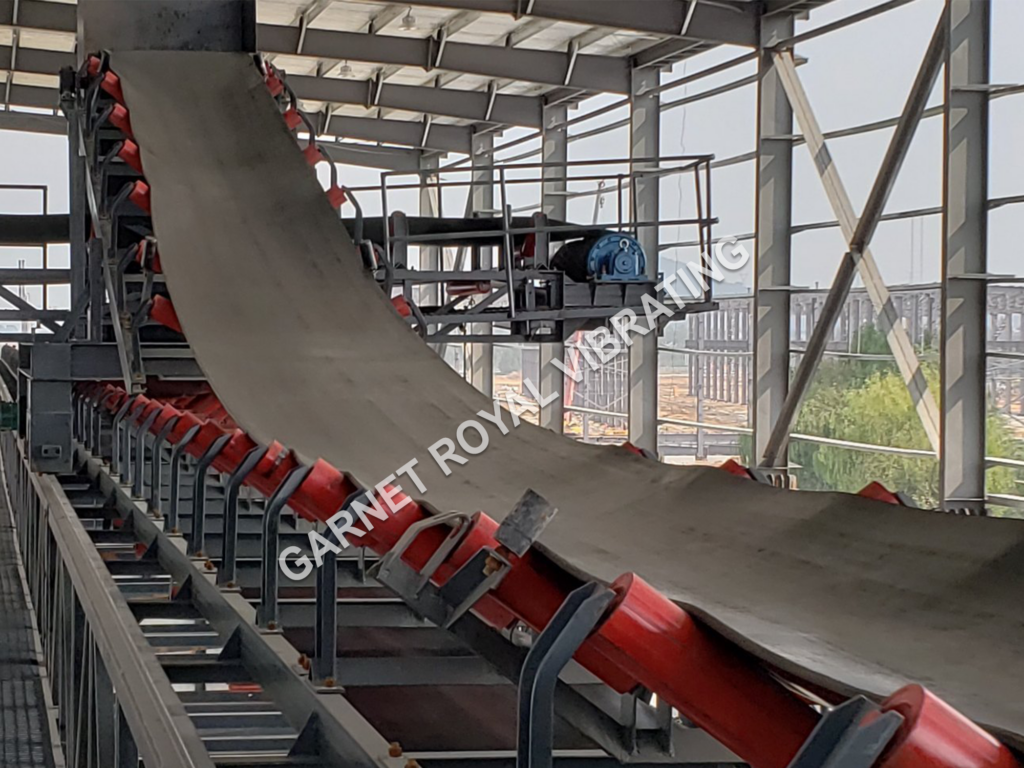
The Garnet Royal tripper conveyor discharges material at any point along a belt run rather than only at the head pulley. A travelling carriage lifts the belt over two pulleys and turns it back on itself, so the load is thrown off into a chute wherever the carriage happens to stand. It is the standard way to fill a long row of bunkers or to build a uniform longitudinal stockpile from one conveyor line.
As an essential component for material handling systems, we design our tripper cars to add versatility and efficiency to conveyor operations. This movable unit is powered along tracks laid along the conveyor frame, allowing it to shuttle back and forth across the length of the conveyor. As materials are conveyed, they reach the tripper car’s position and fall into its discharge hopper, enabling targeted unloading at any desired point along the conveyor. This feature is particularly useful in large-scale operations where materials need to be distributed across different areas or stored in various silos or piles, making the tripper car a vital tool for optimising material distribution and storage strategies.
Diverter Plow
Diverter plows are devices for belt conveyors that require mid-route unloading capabilities. These plows serve as a non-terminal unloading solution, diverting materials from the main conveyor belt to alternative routes or storage areas without stopping the conveyor system. This flexibility is invaluable in operations where materials need to be distributed to various locations along the conveyor path, enhancing efficiency and optimizing material flow within the system
Technical specifications
| Product Type | Belt conveyor |
| Colour | Gray |
| Delivery Time | 1 Day |
| Main Domestic Market | All India |
| Material | Cast Iron |
| Minimum Order Quantity | 1 |
| Supply Ability | 10 Per Day |
| Supply voltage | 400 – 420 Volts |
| Machine weight | 400 – 500 kg |
Specifications are indicative and configured to your application. Share your material, feed size and required output for an exact model recommendation.
Key features
The diverter plow offers a series of features that make it an indispensable part of efficient conveyor system operations, enhancing flexibility and precision in material handling.
- Allows for unloading at any desired location along the horizontal section of the belt conveyor.
- Capable of distributing and unloading the same material into multiple storage bins.
- Facilitates the distribution and unloading of materials into one or several specified bins.
- With the use of a three-way hopper, it can achieve unloading on one or both sides of the conveyor.
- Its simple design ensures easy operation.
- The diverter is integrated into the conveyor line, sharing a single conveyor belt with the belt conveyor system for simple and flexible arrangement and easy maintenance.
- Enables comprehensive material distribution, maximising the use of the site for material stacking.
Frequently asked questions
What is the difference between a tripper and a shuttle conveyor?
On a tripper the conveyor stays put, and only a carriage travels, lifting the belt over bend pulleys to throw material off mid-run. On a shuttle the whole conveyor rides on rails and discharges normally over its own head pulley. A tripper suits long bunker rows; a shuttle suits a handful of bins and coarse, abrasive material.
Can a tripper be added to a conveyor we already run?
Often yes. The existing structure must accept the carriage load and the rails; there must be headroom for the belt to be lifted over the bend pulleys, and the take-up must have enough stroke to absorb belt length across the full travel. We survey the installation; check belt tension and structure, and quote the carriage, rails and chutework accordingly.
Can bunkers be filled automatically?
Yes. With level probes in each bunker and position sensing on the rails, the carriage indexes to the next bunker as each one fills and parks when the row is complete. Semi-automatic control, where an operator selects a bunker and the carriage travels to it, is a common middle option and is simpler to commission.
How is dust controlled at the discharge?
The belt reversal and the drop into the chute both generate airborne fines. We enclose the tripper head, fit skirted chutes with rubber sealing, keep the drop height as short as the layout allows, and provide flanged connections for extraction ducting or a travelling filter unit. Water or fog sprays are offered where the material tolerates moisture.