
Single Roll Crusher
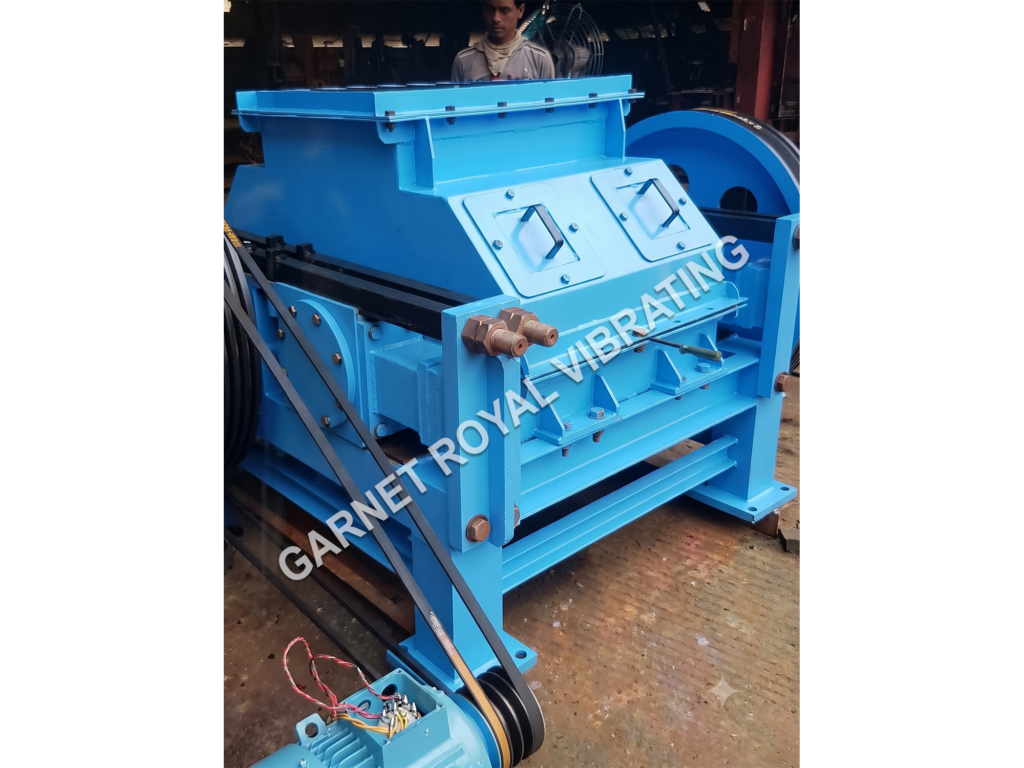
The single-roll crusher handles primary and secondary crushing of soft, non-abrasive, and medium-abrasive materials at a normal crushing ratio of 4:1. One toothed roll turns against a spring-loaded breaker plate, so the feed is gripped and broken rather than pounded—ideal for chalk, coal, coke, clay, and similar friable materials. Garnet Royal builds the machine across a capacity range of 100 kg – 20 TPH, with replaceable roll teeth and an adjustable breaker plate setting.
Technical specifications
| Automatic | No |
| Product Type | Roll Crusher |
| Color | Client choice |
| Capacity | 1 – 20 Tph. |
| Computerized | No |
| Delivery Time | 45 days |
| Feature | Better efficiency |
| General Use | Crushing |
| Main Market | Nepal, Bhutan, Russia, Bangladesh, Zambia, Iraq, |
| Material | Steel casting, MN casting & others. |
| Minimum Order Quantity | 1 |
| Voltage | 400-420 Volts |
Specifications are indicative and configured to your application. Share your material, feed size and required output for an exact model recommendation.
Frequently asked questions
What reduction ratio does a single roll crusher achieve?
A normal crushing ratio of 4:1 applies, so a 200 mm lump reduces to roughly 50 mm in one pass. Pushing for more forces material to recirculate against the breaker plate, which wastes power and wears the teeth. Where a greater reduction is needed, two stages or a following double-roll crusher gives better economics than overloading a single machine.
Which materials suit this machine?
Soft non-abrasive and medium-abrasive materials: chalk, coal, coke, soft limestone, clay, gypsum, salt, fertilizer lumps, and clinker. Hard, abrasive rock such as granite, quartzite, or chromite is outside its range and should go to a jaw crusher instead. If you are unsure where your material falls, send a sample description and we will advise.
How does it compare with a double roll crusher?
The single roll machine accepts larger feed for its size and reaches a 4:1 ratio, making it a good primary or secondary crusher on friable material. A double-roll crusher works at a lower ratio but produces an even tighter product band with fewer fines, so it is usually chosen for final sizing duties downstream of the single roll machine.
What happens if tramp metal enters the crusher?
The breaker plate is spring-mounted, so an uncrushable object pushes the plate away from the roll, passes through the discharge and the springs restore the original setting. The roll, shaft and drive are protected without a shear pin failure or a shutdown. A magnetic separator on the feed conveyor is still recommended for continuously running installations.