
Vibrating Feeder
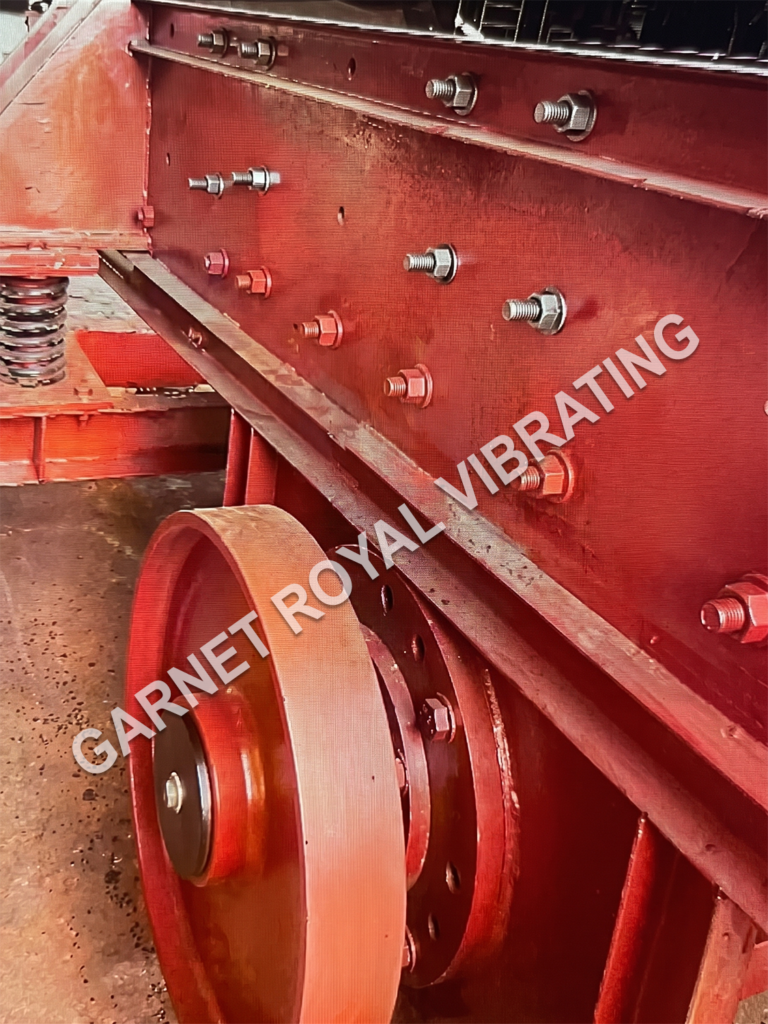
A vibrating feeder draws bulk material from a dump hopper, bin or silo and delivers it onward at a regulated, repeatable rate, so the machine downstream sees a steady stream rather than surges. Garnet Royal builds these in Howrah for quarries, mines, aggregate plants and process lines, in plain pan and grizzly forms and with a choice of drive, covering 100 kg to 100 TPH. In the grizzly form, stepped bars scalp fines, soil and undersize out of the stream before the balance reaches the primary crusher – two duties in one machine, and the reason a feeder at the head of a crushing plant governs the output of the entire circuit.
Technical specifications
| Machine type | Vibrating grizzly feeder (scalping feeder) |
| Duty | Rated feeding of bulk solids from service hoppers to a primary crusher, with integral scalping of fines |
| Drive | Twin counter-rotating unbalanced motor vibrators; exciter gearbox on the largest units |
| Motor supply | 3-phase, 400 – 420 V, 50 Hz |
| Capacity | 100 kg – 100 TPH |
| Maximum feed lump | Up to 1,000 mm |
| Pan width | 800 – 2,000 mm |
| Pan length | 2,000 – 6,000 mm |
| Grizzly section | Replaceable stepped bars, tapered slot 25 – 150 mm |
| Stroke | 6 – 12 mm, adjusted by counterweight |
| Operating frequency | 700 – 1,000 cycles per minute |
| Installed slope | 5 – 10 degrees, downhill |
| Material of construction | Fabricated mild steel body with wear-resistant or manganese steel liners and grizzly bars |
| Finish | Shot-blasted, primed and enamel-painted to your colour standard |
| Service conditions | Suitable for heavy-duty and abrasive applications |
| Machine weight | 4 – 5 tonne |
Specifications are indicative and configured to your application. Share your material, feed size and required output for an exact model recommendation.
Key features
- An integral stepped grizzly removes fines and soil before the crusher, so no chamber capacity is wasted on material that is already in specification.
- Straight-line stroke from twin unbalanced motors — no eccentric shaft and no gearbox to align on standard models.
- Stroke is adjustable by counterweight and feed rate is adjustable by VFD, giving wide turndown from one machine.
- Heavy fabricated pan with bolted, replaceable wear liners in the impact zone under the hopper.
- Tapered grizzly slots open in the direction of flow, so damp fines pass through instead of wedging.
- Spring or rubber suspension isolates vibration from the support steelwork and hopper.
- Rated for heavy-duty and abrasive service, including direct dump-truck loading through a rock box.
- Bar spacing changed on site to match a new crusher setting without altering the feeder body.
Frequently asked questions
What is the difference between a feeder and a conveyor?
A conveyor transports whatever is placed on it and is loaded only at a chute or transfer point. A feeder sits directly under a hopper outlet, carries the weight of the material column above it and sets the tonnage leaving that hopper. In short, a feeder controls the flow and a conveyor merely moves it.
Why scalp before the crusher rather than after it?
Material already smaller than the crusher setting gains nothing by passing through the chamber. Removing it upstream lowers the tonnage the crusher must handle, reduces liner wear and power draw, and stops damp fines from packing between the jaws. The scalped fraction can be sent straight to the product screen or diverted as waste.
Can one feeder handle both fine and coarse feed?
Yes, within limits. The grizzly section is designed around the coarse fraction, and pan width is set by the largest lump. Very fine or dusty material rides well on the same pan, though a sealed cover and dust extraction connection are usually added. Where the feed is entirely fine, an electromagnetic vibrating feeder is the more economical machine.
How is the feed rate adjusted once the plant is running?
Day to day adjustment is made from the variable frequency drive, which alters vibrator speed and therefore conveying velocity. Larger, permanent changes are made by resetting the counterweights on the vibrator shafts to lengthen or shorten the stroke. Both can be interlocked with the crusher load so the feeder slows automatically when the chamber fills.